

Prologis
CEF Lead Executives
-
JOHN HOEKSTRAList Item 1
SVP, Global Sustainability
John is responsible for leading the strategy and development of sustainability solutions for Prologis customers as well as collaborating on Prologis’ own sustainability goals and plans. His focus is on scaling up renewable energy, zero emissions mobility solutions, and other initiatives around sustainable logistics in support of Prologis' net zero commitment and customer needs to decarbonize. Prior to joining Prologis, John was the Global VP of Sustainability at Schneider Electric. During his 16-year tenure with the company, he led the evolution, strategy and delivery of cleantech, sustainability, and NEO Network™ services. His work included climate strategy and planning, renewable energy advisory and deployment, ESG framework evaluation and management, opportunity creation in circularity, and supply chain management for sustainability for global Fortune 1000 companies. Previously, John held various positions in environmental management with Dell Computer, E.I. DuPont de Nemours, and Brown-Forman. John has a bachelor’s degree in chemical engineering from the University of Louisville and is a registered professional engineer.
-
SUZANNE FALLENDER
VP, Global Impact and Sustainability
Suzanne leads Prologis’ global impact and sustainability strategy, public reporting, and strategic initiatives to elevate the company's leadership in sustainable logistics. Working with groups across Prologis, Suzanne and her team advance the integration and scale of sustainability and social impact strategies and goals, including Prologis’ net zero goal. She proactively engages with investors and other stakeholders, and partners closely with the company's finance, governance, operations and IT teams on integrated ESG reporting and data strategies. Suzanne also serves on the board of the Prologis Foundation. Prior to joining Prologis, Suzanne served as global director of corporate responsibility at Intel Corporation and as vice president at Institutional Shareholder Services where she led the firm’s social investment research division. Suzanne holds an M.B.A. from the W.P. Carey School of Business at Arizona State University and a B.A. from Trinity College in Hartford, CT. She has served on multiple industry advisory boards over the past decade, and currently serves on the board of the non-profit Net Impact.
-
ALLISON SCHWEIZER
Global Energy & Sustainability Program Manager
-
WESLEY (WES) HERCHE
Director of Enterprise Sustainability
Wes helps drive the development and deployment of energy, mobility, and sustainability (EMS) solutions for Prologis customers and partners. Prior to joining Prologis, Wes held leadership roles in sustainability and strategy in top tier companies across various sectors. He led decarbonization and renewable energy initiatives at Amazon and AWS, and was a key member of the product management team that built and launched the Amazon Sustainability Solutions Hub. As a strategy consultant at Boston Consulting Group, Wes developed clean energy transformation strategies for major corporations. At Arizona State University, he led the development of external partnerships and interdisciplinary research programs in sustainability and national security. Wes is also active in the Climate Tech community, advising and mentoring founders in several startups focused on decarbonization. Wes holds an MBA from the Thunderbird School of Global Management and a PhD in Sustainability from Arizona State University.
-
MELCHERT DUIJVE
Global Enterprise Sustainability Director
-
SAMANTHA KLUG
Enterprise Sustainability Director
-
MADDIE STOEHR
Global Energy & Sustainability Associate
Latest Sustainability Reporting
Highlights
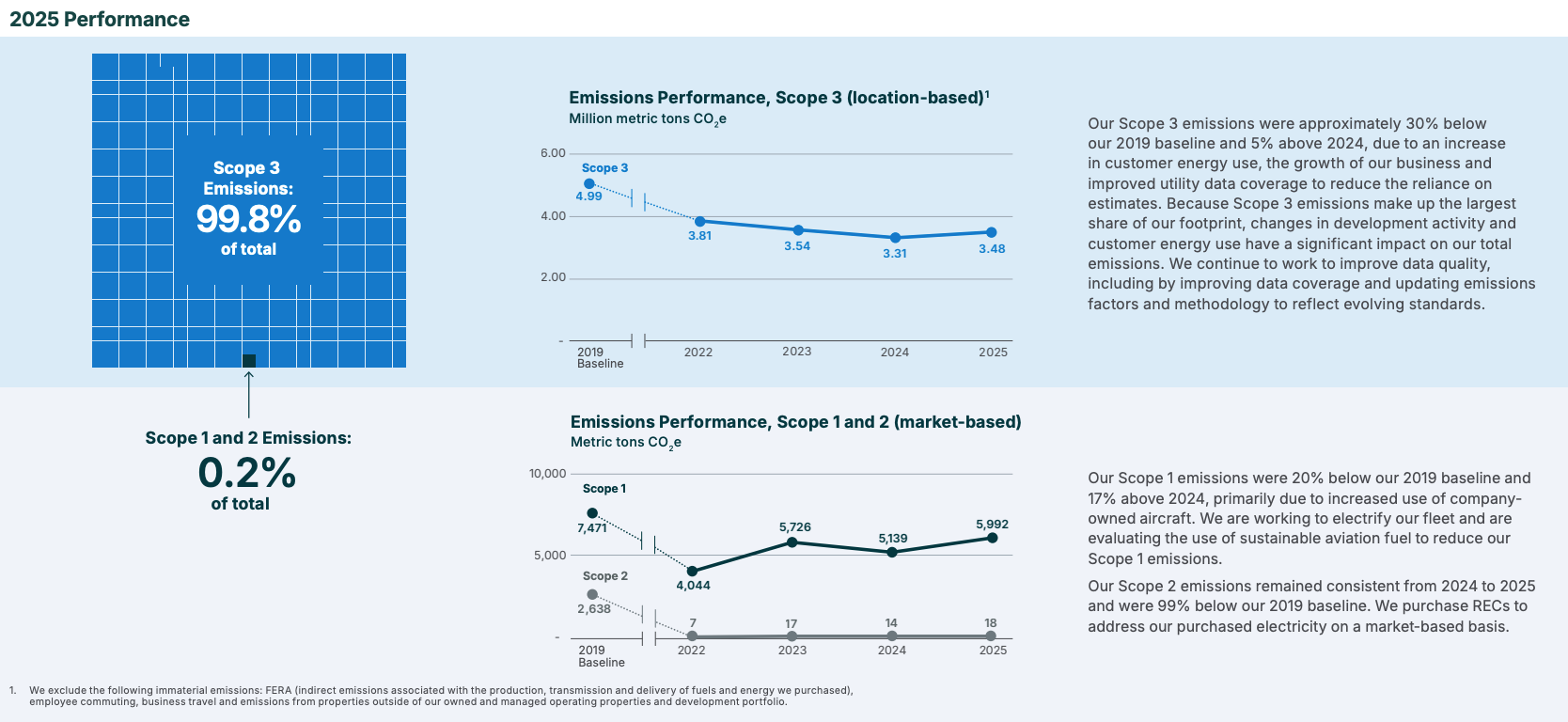
- Reduced Scope 1 emissions by 20%, Scope 2 emissions by 99%, and Scope 3 emissions by 30% (2019 baseline).
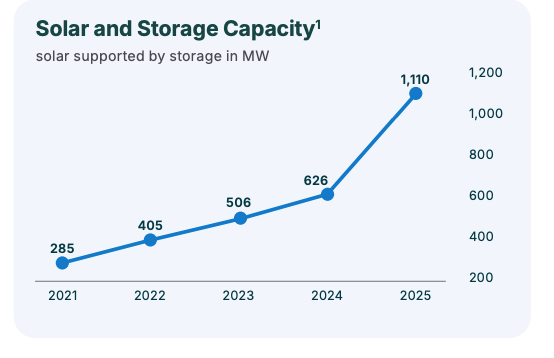
- Reached 1.1 GW of solar generation and storage capacity, surpassing its 2025 goal of 1 GW.
- Achieved LED lighting across 83% of its portfolio, up from 79% in 2024.
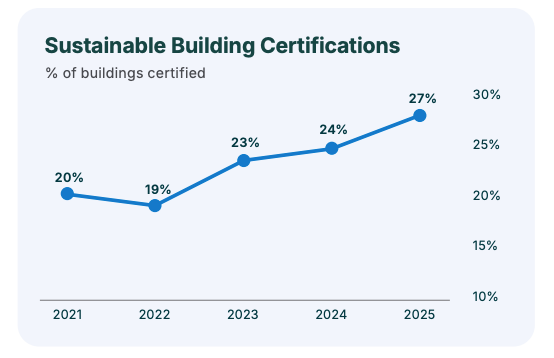
- Achieved or in the process of achieving sustainable building certifications for 100% of eligible projects.
- In 2025, piloted mass timber across over 250,000 square feet in five projects to replace higher-carbon structural elements.
- Employees volunteered 21,662 hours to community organizations in 2025.
- A 2025 third-party analysis of compensation found no pay disparities for people of color in the U.S., and that women (globally) were paid within +/-3% of their male peers.
- Women made up 50% of the employees companywide, and people of color made up 35% of employees in the U.S.
in 2025.
Recent News
2026
Lower-carbon concrete solutions playbook —
The Climate Pledge and MIT’s Concrete Sustainability Hub
are developing a playbook that aims to facilitate the transition to greener concrete solutions,
making it easier for architects, designers, engineers and owners
to identify effective, lower-carbon concrete solutions
and for producers to develop a broader array of such offerings.
The free playbook (aimed for 2027), will run on generative AI,
recommending concrete mixes that meet structural requirements, are available nearby, comply with local building codes, and reduce embodied carbon. It will also expand as new technologies come online. The project
includes CEF members Amazon and Prologis
(which signed on as the first Climate Pledge signatory) and is the
first phase of MIT’s effort to develop an industry consortium
called the Program for Advancing Climate-smart Concrete Transformation (PACCT). (Aug 2026)
2025
Sustainable Concrete Buyers Alliance (SCoBA) — This buyers group aims to accelerate the market for and investment in sustainable concrete. It will collectively procure environmental attribute certificates for low-carbon concrete, and channel investment into offtake agreements to enable producers to scale up. Organized by RMI and Center for Green Market Activation, the initiative brings together founding members, including CEF members Amazon, Meta, and Prologis, and is open to additional participants (via email here). SCoBA has also launched a Request for Information (open until 17 October 2025) to gather input from cement producers and innovators on advancing low-carbon solutions, which will inform the launch of the first request for proposals (RFP) in late 2025 or early 2026. (Sept 2025)
CORPORATE KNIGHTS — Published its 2025 Global 100 List, ranking the world’s most sustainable companies (with revenues of over $1 billion) along 25 indicators. For the companies in the Top 100 in 2025, 53% of their total revenue was sustainable as was 58% of their total investments. This compares to 15% of total revenue and 15% for total investments for the 8,259 other publicly traded companies with revenues of over $1 billion. The top ranked company was CEF Member Schneider Electric, moving up from #7 in 2024. Other CEF Members in the Top 100 included Trane Technologies (#26), Cisco (#54), SAP (#58), Prologis (#63), Apple (#69), Unilever (#71), and HP Inc. (#79). (Jan 2025)
2024
Powering America’s Commercial Transportation (PACT) — This new coalition will focus on education and advocacy to support the deployment of commercial zero-emission vehicle (ZEV) infrastructure in the U.S. for medium- and heavy-duty (M/HD) ZEVs. Established by Daimler Truck North America, Navistar, Inc., and Volvo Group North America (which represent 70% of new M/HD truck sales), the coalition is open to all stakeholders interested in accelerating the deployment of zero-emission commercial vehicles. CEF member Prologis is also a founding member. (Feb 2024)
CORPORATE KNIGHTS — Released its 20th annual Global 100 List, ranking the world’s most sustainable companies along 25 indicators, out of 6,000 public companies with revenues of over $1 billion. In 2024, top-ranked firms allocated 55% of their investments to sustainable projects, up from 47% last year, and compared to just 17% of investments of publicly traded companies with more than $1 billion in revenue. The top ranked company was Sims Ltd, an Australian waste management company that moved up from #14 in 2023. CEF Members in the Global 100 include: Schneider Electric (#7), Trane Technologies (#23), Cisco (#64), HP Inc. (#67), Apple (#71), Unilever (#76), Hewlett Packard Enterprise (#81), and Prologis (#87). (Jan 2024)
2023
Joined the CEF member network in August 2023!
2022
Announced its commitment to achieve net zero emissions across its value chain (Scopes 1-3) by 2040. The commitment—which contains interim targets to achieve a) 1 gigawatt of solar generation capacity, supported by storage, by 2025; b) carbon-neutral construction by 2025; and c) net zero for operations by 2030—has been submitted to the Science Based Targets initiative (SBTi) for validation. (June 2022)
2021
“Retail Carbon Footprints: Measuring Impacts from Real Estate and Technology” (MIT and Prologis) finds that carbon emissions from online shopping are 36% lower on average than those produced by in-store trips. The report also found that a full standard delivery van can replace more than 100 individual car trips to a store, with fleet electrification increasing this advantage further. (January 2021)